+1 309 791 4105

 hyperlink.infosystem












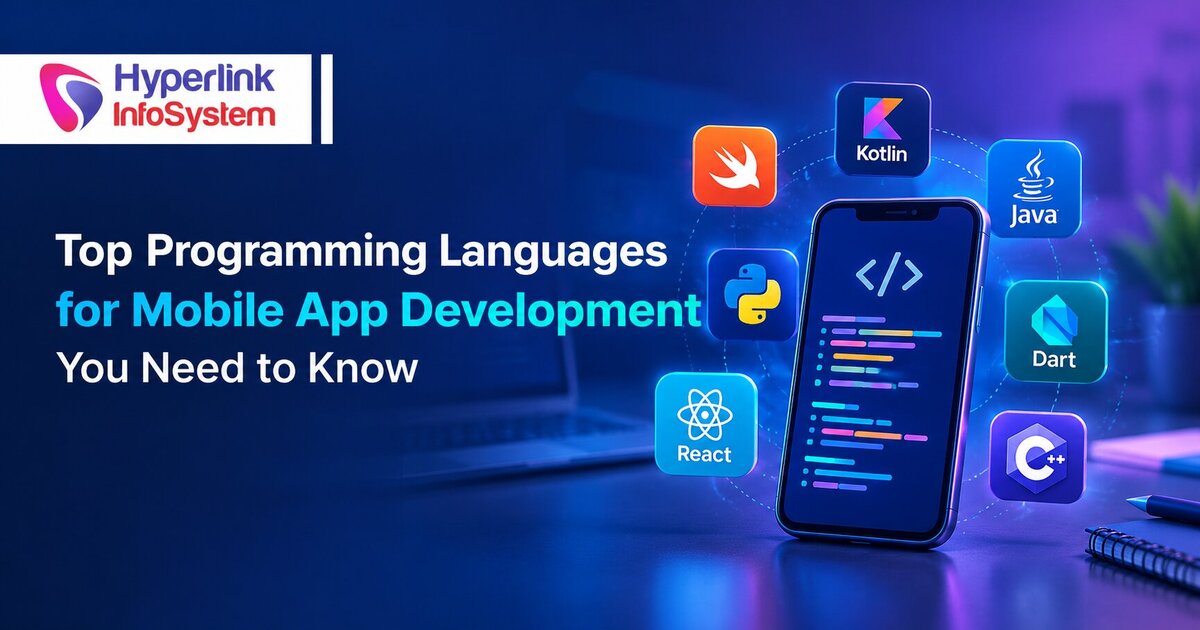

An application feature set for a mobile phone may appear simple enough to plan. However, the technologies that would be needed to implement such a feature set would differ. Making payments securely, integrating into the company’s existing system, accessing the capabilities of the device, or porting to another platform will have varying technological needs.
The implications are quite high in Canada. As per Grand View Research, the mobile application market in the country is expected to hit US $28.13 billion by 2026 with a forecast CAGR of 16.1% till 2033. This perspective on the market will serve as a good benchmark for companies considering their mobile product options.
The ecosystem for programming is growing too. According to the Business Research Company, the programming languages market is expected to reach US $220.81 billion in 2026, up from US$199.56 billion in 2025. While this forecast includes all the programming technologies in different types of software, it demonstrates the growth of the industry behind such technologies.
For any available mobile app development language, there are various aspects associated with it, including advantages and disadvantages. The difficulty lies in choosing a technology that will suit your needs but not make the system too complicated to manage.
Why Choosing the Right Mobile App Development Language Matters
Deciding on the mobile app development language can influence the manner in which the application’s features are developed, how it will be integrated into other systems, and the ease with which the developers would maintain the code in light of any changes to the requirements.
There are several considerations that should be taken into account before choosing a programming language for developing the mobile app.
Feature Requirements
The software that needs real-time updates, transactions, locations, and device hardware might need certain programming languages and platforms. The technology selected has to be able to do all these operations.
System Integration
The application may require exchanging information with other enterprise applications such as CRM, inventory system, payment gateway, or API internally. Compatibility of the app with other systems may impact the degree of difficulty involved in implementation and testing of the mobile app.
Skill of Developers
Having a language familiar to the development team can be beneficial for smooth collaboration and learning. The libraries, documentation, and community support of the specific language also assist in solving technical problems.
Maintenance in the Long Run
Updates to the system, security, features, and evolving business needs impact the application beyond deployment. The availability of technology and developer communities makes this process easier.
Budget and Delivery Timelines
Availability of the developers, the need for integration, testing, and the learning curve may affect the total cost of mobile application development. All these factors need to be considered while planning the mobile application project.
The most important thing would be to consider the app's needs instead of selecting a language simply because it is currently trendy. After that, the choice of development strategy will become another factor to take into account since native and cross-platform app development differ greatly from each other.
Native vs. Cross-Platform Mobile App Development Languages
Development on the native or cross-platform platform can be seen as an option to develop mobile apps for iOS and Android systems. In the former case, there is a use of the development technology for the particular operating system. Whereas in the latter one, there is an ability to reuse the codebase for the particular application.
Native vs. Cross-Platform: Key Differences
|
Consideration |
Native Development |
Cross-platform Development |
|
Codebase |
Platform-specific implementations |
Similar coding across multiple platforms wherever possible |
|
Languages |
Swift, Kotlin, Java |
Dart, TypeScript, JavaScript |
|
Device Integration |
Direct access to platform APIs |
Platform-specific integration might be required for some functionality |
|
User Experience |
Granular control over platform conventions |
Similar user interfaces that work across different platforms with necessary tweaks |
|
Team Requirements |
Usually needs knowledge of the ecosystem of each platform |
Much of the development can be done within one framework |
|
Maintenance |
Platform-specific updates and testing |
Updates and testing on all target platforms |
Top 10 Programming Languages for Mobile App Development
Different programming languages can be used for developing mobile applications based on various factors such as platforms, functionality, and others. Below is a table that shows the main differences among them, along with their features and shortcomings.
|
Language |
Best Suited For |
Key Advantage |
Key Limitation |
|
Kotlin |
Native Android apps |
Modern syntax and Android-first development tools
|
Does not automatically generate a shared iOS codebase |
|
Swift |
Native iOS apps |
Good integration with the Apple ecosystem
|
Mainly concentrates on Apple-based platforms |
|
Dart |
Cross-platform apps with Flutter |
Single code base and unified UI development
|
Some functionalities need platform-dependent implementations |
|
TypeScript |
Cross-platform apps with React Native |
Static typing enables maintenance of code
|
Needs to be compiled into JavaScript |
|
JavaScript |
React Native apps and web-connected products |
Wider ecosystem and transferable skills
|
A large codebase can become difficult to handle without type checking
|
|
Java |
Existing Android and enterprise apps |
Good libraries and existing code bases
|
More verbose compared to some other languages |
|
C# |
Cross-platform apps using .NET MAUI |
Integration with the .NET ecosystem
|
Ideal for developers experienced in .NET technologies |
|
C++ |
Games and performance-intensive components |
Fine control of performance
|
Higher level of implementation complexity |
|
Python |
Backend services, AI features, and prototypes |
Development productivity for supporting services
|
Less used in native mobile interfaces |
|
SQL |
Data storage and retrieval |
Efficient querying of structured data |
Does not create mobile interface or application logic |
1) Kotlin
Kotlin is an emerging programming language that has static typing and is natively supported by Google to develop applications for Android. It has been designed to become a replacement for Java and, therefore, provides compact syntax and null safety paradigms.
Use Cases: Native mobile applications for Android and UI built on Jetpack Compose with Kotlin Multiplatform support for shared business logic.
2) Swift
Swift is the name of the native open-source programming language created by Apple that allows for rapid, secure, and interactive software development. Swift boasts high readability, memory management, and close integration with modern declarative frameworks.
Use Cases: iOS native application development language, high-reaction iPadOS system, and spatial application on native visionOS.
3) Dart
Dart is an object-oriented programming language with a client-first approach designed specifically for fast development of applications in all kinds of platform environments. The Dart programming language takes advantage of JIT compilation and AOT compilation for attaining native execution speed.
Use Cases: Enabling the development of applications on the Flutter application platform across different platforms and customizing retail marketplaces.
4) TypeScript
TypeScript is an open-source syntactic superset of JavaScript designed by Microsoft. It is an added feature to JavaScript that inserts type definitions into the source code. It acts as a safety measure in architecture where developers can identify type conflicts before compiling the application.
Use Cases: Building scalable React Native applications, managing huge shared mobile libraries, and helping web engineers make a seamless transition into cross-platform mobile application development.
5) JavaScript
JavaScript is a dynamic scripting language that serves as one of the cornerstones of modern web technology frameworks. JavaScript has a wide ecosystem that allows it to be used not only in the common browser setting but also in other settings, which makes it easy to develop mobile apps.
Use Cases: Developing hybrid apps using React Native, developing MVP web applications, code transferability from web to mobile interfaces.
6) Java
Java is a well-developed, class-based, and object-oriented system designed to have the minimal number of execution dependencies. This platform has been serving the worldwide corporate software industry for many years now, depending on the guaranteed security and predictability of the standard virtual machine runtime environment.
Use Cases: Developing deep Android applications in various languages, managing banking websites, and supporting old commercial database systems that can’t be migrated.
7) C#
C# Programming Engine is a programming language that is designed by Microsoft to run in a seamless manner within the extensive .NET framework. The language merges the computational power of low-level languages with high-level abstractions to enable developer efficiency.
Use Cases: To launch business cross-platform applications through the .NET MAUI framework and design sophisticated 2D and 3D mobile video games using the Unity framework engine.
8) C++
C++ represents an extension to the traditional C architecture, offering highly detailed and low-level control over system hardware, memory management, and computation execution parameters. This enables C++ to circumvent the overhead of complex runtimes and produce the fastest raw computation speeds available.
Use Cases: Building highly complicated custom physics engines for mobiles, processing images and videos in real time, and developing graphics-intensive modules using the Android NDK.
9) Python
Python is an interpreted programming language with a reputation for being highly readable and having very fast execution speeds. Even though Python cannot be compiled into a user interface for a client-side application, it is excellent for handling the backstage processes of data processing.
Use Cases: As a backend for smart applications, creating rapid cloud prototypes, as well as on-device machine learning architecture and NLP models.
10) SQL
Structured Query Language (SQL) represents the standardized language of choice that has been created with the purpose of managing, sorting, and analyzing records in relational database management systems.
Use Cases: Creating secure transactional databases on local devices using SQLite database engines, dealing with relational queries, and synchronizing offline user application caches with the enterprise cloud network.
How to Choose the Best Language for Your Mobile App
Choosing a programming language to develop an application is something that requires considering some aspects from the technical perspective, the skills of the developers, and the future of the product itself. A structured analysis will guarantee that there will be no need for any expensive rework during the process, and the selected technology stack will support the mobile app as it grows.
Here are the six questions to ask before making a decision:
Which platform do we need for the application?
It must be decided whether the release of the app requires iOS, Android, or both. It will help us narrow down the list of iOS app development languages and Android app development languages.
Does the app require integration into the device and graphics to be intensive?
Those applications that must support Bluetooth connectivity, AR capabilities, camera control, and intensive graphics can usually take advantage of native mobile app development using Swift for iOS and Kotlin for Android.
How much can we reuse code?
Consider places where you will be able to reuse your business logic, models, and API. Cross-platform app development for mobile devices helps you to eliminate duplication, yet there are things that you cannot duplicate as they are platform-specific.
What are the competencies available to the team?
Think about the existing competencies, ability to recruit such a team, and training requirements. The web development team will be much more familiar with JavaScript or TypeScript, while the native application team will appreciate Swift or Kotlin.
What is the frequency of application updates?
Applications that frequently roll out new features require being designed in a way that the process of testing and deployment is efficient. Although reusable code can assist in application updates, it needs validation on each platform.
Common Mistakes to Avoid
A highly researched selection can cause problems if the decision-making process fails to consider some key issues.
- Selecting only based on popularity: Sometimes an app is not necessarily built in one of the popular languages.
- Defining the requirement after selecting the framework: Before you decide on choosing any framework such as Flutter, React Native, etc., analyze the functionality of the product.
- Neglecting maintenance: Updating, fixing bugs, security patches, and compatibility testing with the operating systems all require development.
- Assuming that one codebase reduces work for other platforms: Sometimes code can be reused, but some additional coding for each platform may be needed.
An objective assessment of these aspects can help in narrowing down the best programming languages for mobile app development, without relying on current trends. This will provide the development team with an objective approach towards budgeting and estimating mobile app development costs.
Why Partner with Hyperlink InfoSystem for Mobile App Development in Canada?
Hyperlink InfoSystem enables businesses to develop robust mobile applications based on their intricate product requirements by providing technological consulting, custom UI/UX design, and development services. Our engineers can help you identify the right technologies and architecture for a secure application and provide integration solutions that suit your business needs.
As one of the leading mobile app development companies, we collaborate closely with our clients to design applications with respect to their requirements and future plans for business growth. If you are looking to hire mobile app developers for creating your own digital product or corporate app, our professional developers will provide the necessary level of technical expertise required throughout the app development.
Ultimately, the appropriate technology choice should always be geared towards meeting your business purposes in relation to the product. If you are willing to learn more about technology choices for your mobile applications, feel free to connect with us.







 +91 8000 161161